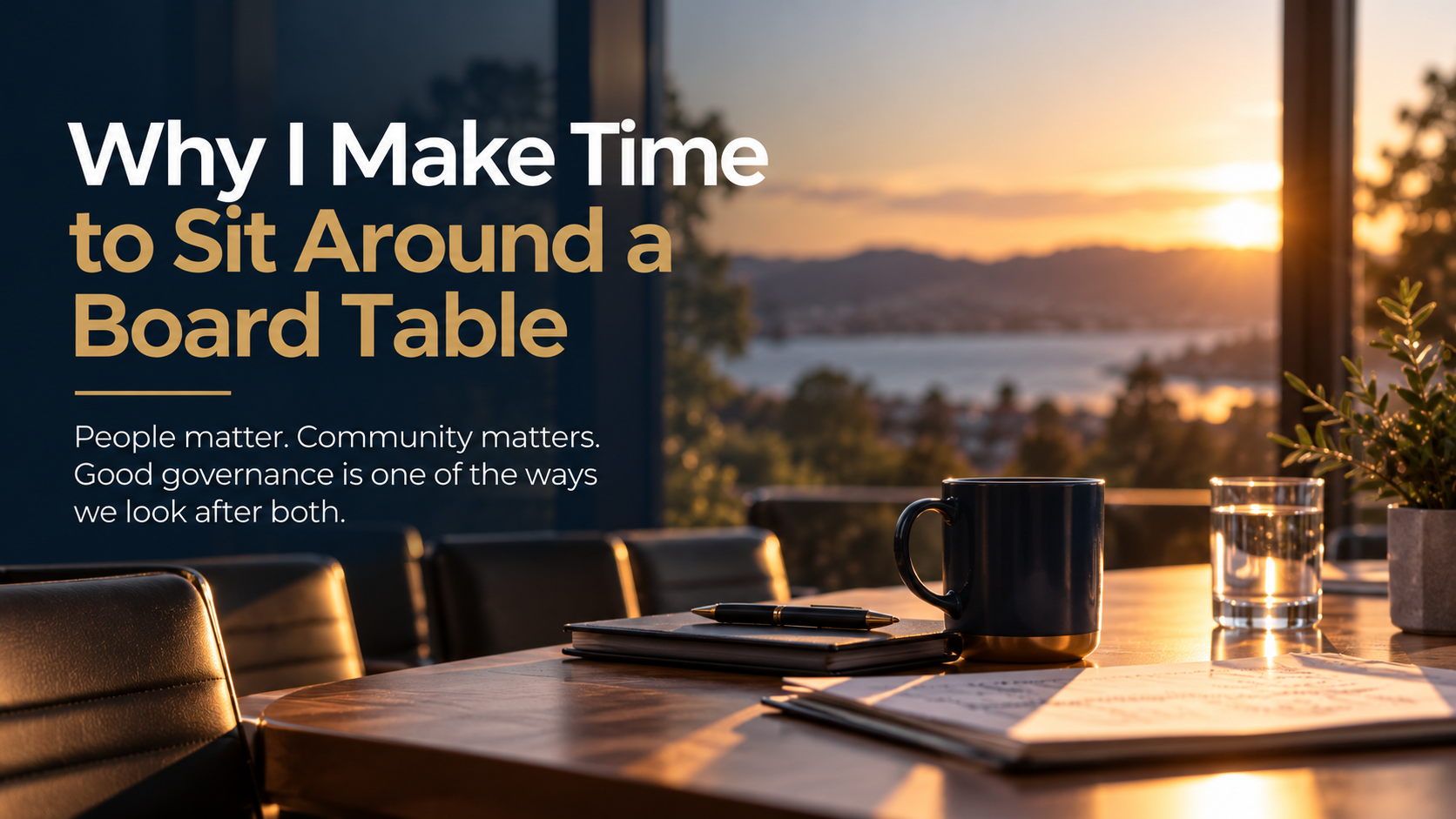
People matter. Community matters. Good governance is one of the ways we look after both.
I was having a conversation recently about a prospective board appointment when someone asked me why, with everything else I've got going on, I deliberately go out of my way to make time to serve on community boards. It's a fair question, and one I've found myself thinking about since. Between work, being a dad and the usual demands of life, it's not as though I've got an abundance of spare time. Yet I keep finding myself putting my hand up for these opportunities, often knowing full well that they'll involve another commitment in an already busy calendar.
The simplest answer is that I genuinely enjoy it. Not everyone's brain gets tickled by governance, risk, financial oversight and strategic planning, but mine does. I enjoy understanding how organisations work, asking questions that perhaps haven't been asked before and helping people work through complicated decisions. There's something particularly satisfying about being part of a conversation that moves an organisation forward, especially when it involves bringing different perspectives together to find a better way of doing things.
But if it were just about enjoying budgets, risk registers and strategic plans, I'd probably find another hobby. What really motivates me is the people and communities behind the organisations.
I've spent a significant part of my professional life working with community organisations and not-for-profits, and I've seen firsthand the difference they make. Often they're operating with limited resources, stretched teams and volunteers who give far more of themselves than anyone could reasonably expect. They're the organisations people turn to when life becomes difficult, when they need support, connection or simply someone willing to listen. They're also the places where people come together, relationships are built and communities become more than just a collection of people living in the same geographical area.
I think we sometimes underestimate how important these organisations are, particularly the smaller ones quietly getting on with the job without much recognition. Their work matters enormously, and I believe the responsibility of governing them deserves to be taken just as seriously as the work happening on the ground.
Knowing when to say no, and when to think bigger
One of the things I've come to appreciate through serving in roles such as Treasurer is that good governance isn't always about supporting the most exciting idea in the room. Sometimes my responsibility is to be the person asking whether we can afford something, whether we've properly considered the risks or whether a particular decision is genuinely in the organisation's best interests in both the long and short. There are occasions when the answer needs to be no, even when the idea itself is a good one and the people advocating for it are passionate about making a difference.
Those conversations aren't always comfortable, particularly in community organisations where people care deeply about the work they do. I never want to be the person who dampens enthusiasm simply for the sake of being cautious, but I've also seen how easily good intentions can lead organisations into difficult positions when the financial or operational realities haven't been properly considered. Saying no isn't necessarily a lack of belief in the mission. Sometimes it's precisely because you believe in the mission, and want to make sure the organisation is still around to deliver it in five or ten years.
Equally, I think there are times when my responsibility is to push the boat out a little further. People working in operational roles are understandably focused on what's happening in front of them. They've got services to deliver, staff and volunteers to support, problems to solve and an endless list of things that need attention. I've worked on that side of the table too, and I know how difficult it can be to find the time and headspace to look beyond the immediate demands of running an organisation.
One of the privileges of serving on a board is having the opportunity to take a broader view. To look beyond the next roster, the next funding round or the next operational challenge and ask where the organisation could be in five or ten years. Sometimes that means challenging the thinking around the table, asking whether we're being ambitious enough or whether we've allowed the limitations of today to shape what we believe is possible tomorrow. It's not about directors having better ideas than the people delivering the services. It's about recognising that governance and operations bring different perspectives, and that organisations are stronger when those perspectives work together.
I don't believe boards should be running the day-to-day operations of an organisation, but I also don't believe their role is simply to receive reports, approve recommendations and go home. Good directors need to be curious, willing to challenge assumptions and comfortable having difficult conversations. They also need the humility to recognise when someone else knows more than they do, and the wisdom to know when to step back and let people get on with their jobs.
Finding that balance between protecting what an organisation has built and encouraging it to pursue what it could become is one of the parts of governance I find most rewarding.
The responsibility that comes with community trust
Something I care deeply about is the reputation community organisations hold within the communities they serve. That reputation isn't simply a brand or a public relations exercise. It's built through years of relationships, conversations, acts of service and people having positive experiences when they've needed help. In many ways, an organisation's reputation belongs just as much to the community that has supported and trusted it as it does to the people responsible for running it.
When someone approaches a community organisation, they're often placing a significant amount of trust in the people behind it. They might be sharing personal information, asking for financial assistance, seeking support during a difficult period or allowing someone into a particularly vulnerable part of their life. They're trusting that the organisation will treat them with dignity, act responsibly and do what it says it's going to do. That trust can take decades to establish and remarkably little time to damage.
This is why I've never been particularly comfortable with the idea that governance is primarily about compliance. Of course, financial accountability, policies, risk management and regulatory obligations matter, but they're not the reason community organisations exist. They're part of how we protect the people who depend on them and the mission they've been established to pursue. A well-governed organisation is better placed to make responsible decisions, support its people and continue delivering services long after the current directors have moved on.
I've seen enough to know that being passionate about a cause doesn't automatically mean an organisation is being managed or governed well. Good intentions don't remove financial risks, prevent poor decisions or guarantee that the right safeguards are in place. If anything, I think organisations that exist to serve their communities have an even greater responsibility to get these things right, particularly when the people relying on them may have limited alternatives.
For me, that's where governance becomes deeply personal. The decisions made around a board table might appear removed from the day-to-day experience of a client, volunteer or community member, but the consequences of those decisions can be felt for years. I think directors owe it to those people to take their responsibilities seriously, even when the work is difficult, uninteresting or unlikely to attract any recognition.
Building the kind of community I want my kids to inherit
There's another reason I make time for board roles, and it's probably the most personal one. I'm a dad, and I spend a fair bit of time thinking about the kind of community my kids are growing up in and the world they'll eventually inherit. I want them to live somewhere people look out for one another, where those who are struggling aren't forgotten and where community means more than a word in an organisation's mission statement.
I want them to see that being part of a community comes with some responsibility for it. That we don't have to wait for someone else to solve every problem, and that each of us has something we can contribute to making the places we live a little better. I certainly don't have all the answers, and I'm under no illusion that sitting on a few community boards is going to change the world, but I do believe that meaningful change often starts with ordinary people choosing to contribute what they can.
For some people, that's volunteering in a kitchen, coaching a sporting team, checking in on an elderly neighbour or helping organise a community event. For reasons I still find slightly amusing, I happen to enjoy budgets, governance frameworks, risk registers and strategic planning. They're skills and interests I've developed through my professional life, and being able to use them in service of organisations that are making a difference feels like a worthwhile way to give something back.
Sometimes that contribution might be helping an organisation make a difficult financial decision so it can remain sustainable. Other times it might be encouraging a board to think beyond what it currently does, helping people see an opportunity they hadn't considered or asking a question that changes the direction of a conversation. Most of that work happens quietly, away from the people who ultimately benefit, and I'm perfectly comfortable with that. I don't think community service needs to be visible to be valuable.
Of course, none of this means I always get it right. There are times when I've probably pushed too hard, been too cautious or approached a conversation with a view that changed once I understood someone else's perspective. That's part of the responsibility too. Serving on a board doesn't mean having all the answers, and I've learned that being willing to listen, reconsider and occasionally admit you were wrong is just as important as being prepared to speak up.
So when someone asks why I keep finding time for board roles, I suppose the answer is a combination of things. I enjoy the intellectual challenge, the relationships and the opportunity to contribute to decisions that can make an organisation stronger. I enjoy working alongside people who genuinely care about their communities, even when we don't always agree on the best way forward.
More than anything, though, I believe the organisations that hold our communities together are worth investing in. They deserve people who are willing to ask difficult questions, protect the trust placed in them and help them imagine a future beyond their immediate challenges.
If giving some of my time, experience and energy to that work helps create a slightly better community for my kids and the generations that follow, then I reckon it's time well spent.

0 Comments