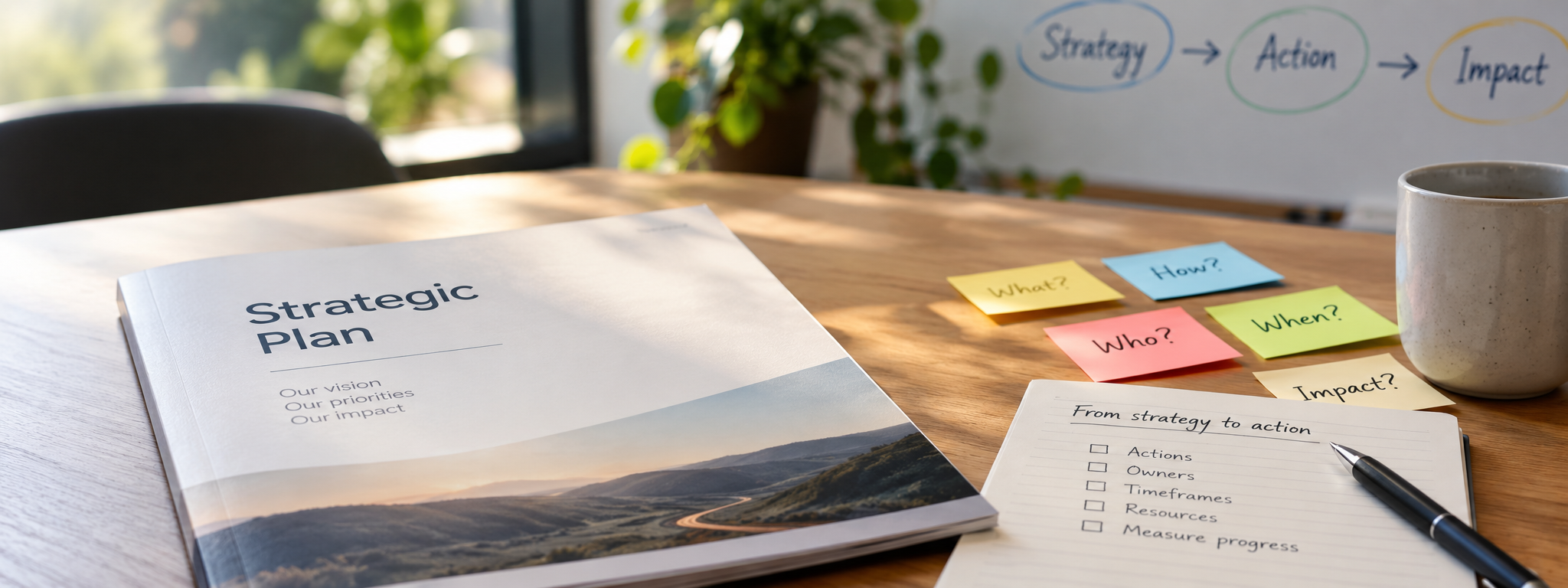
A strategic plan tells us where we want to go. The harder part is working out how we’re actually going to get there.
I spend a fair bit of time working with policies and procedures, and there is a distinction between the two that most organisations understand pretty well. A policy sets out what we are going to do and why it matters. The procedure underneath it works through how we are actually going to do it.
Take conflicts of interest as an example. A policy might say that conflicts need to be identified, declared and appropriately managed. That's important, but it doesn't tell someone what to do when a conflict actually arises. We still need to decide how it is declared, where it is recorded, who needs to know about it, whether someone needs to step out of a discussion and how the decision is documented. The policy gives us the position; the procedure makes it work in practice.
I've started to think about strategic planning in much the same way.
Boards can spend an enormous amount of time developing a strategic plan. There are workshops, consultations, planning days and plenty of discussion about where the organisation is today and where we want it to be in three or five years. Eventually we land on a handful of strategic priorities, approve the plan, make it look presentable and perhaps publish it on the website.
Then everyone gets back to work.
This is the point where I think we need to ask a fairly simple question: what are we actually going to do about it?
The strategic plan is the what and the why
A good strategic plan should give an organisation direction. It should help us understand what we're trying to achieve, why those things matter and where we want the organisation to be at the end of the planning period. It doesn't need to contain every project, task or operational decision that will happen over the next three years.
The problem is when there is nothing underneath it.
We might have a strategic priority to strengthen our connection with the community and develop meaningful partnerships. That sounds reasonable and might be exactly what the organisation needs, but it still leaves a lot unanswered. What does strengthening our connection with the community actually look like? Which partnerships are we trying to develop? What are we going to do differently this year compared with last year, and what would we expect to see if we're successful?
The same thing happens with priorities like invest in our people, improve organisational sustainability, strengthen our digital capability or increase our community impact. They all sound like things most organisations would want to do, but they aren't actions in themselves.
This is where the comparison with policy and procedure becomes useful for me. If the strategic plan gives us the what and the why, we still need something underneath it that gives us the how.
Where is the action plan?
I don't think the answer is making the strategic plan itself a fifty-page document full of operational detail. In fact, that probably makes it less useful. The strategic plan should remain relatively high-level and give the organisation a clear direction.
What I want to see underneath it is an implementation or action plan that turns those priorities into something people can actually work towards.
If we're going to strengthen community partnerships, perhaps this year we're going to establish formal referral relationships with three organisations, create a community advisory group or develop a partnership with another service provider to address a particular gap. If we're going to improve digital capability, perhaps we're replacing a legacy system, improving cyber maturity or automating a process that currently consumes hours of staff time every week.
Once we've worked out those actions, we can start answering the practical questions. Who owns this? When are we going to do it? What resources will it require? What does success look like? How will we know whether it worked?
For a three-year strategy, I like the idea of having a broader roadmap across the life of the plan with more detailed actions for the year immediately ahead. There is very little value in pretending we know exactly what the organisation will be doing in the third quarter three years from now. Funding changes, governments change, technology changes and the needs of communities change. The strategic direction can remain consistent while the way we get there adapts along the way.
Doing something doesn't necessarily mean we're getting somewhere
There is another trap once we start building an action plan. It becomes very easy to measure whether we did something rather than whether doing it actually achieved anything.
If our strategy is to strengthen community partnerships and our report says staff attended twelve networking events, I know we've been busy. I don't necessarily know whether our partnerships are any stronger.
The same applies to technology. If our strategic priority is improving digital capability and we report that a new system has been implemented, that's useful to know, but buying software wasn't really the outcome we were looking for. Has the system reduced administration? Has it improved the quality of our data? Are staff actually using it? Has it improved reporting or made it easier for people to access our services?
This is why I think the action plan needs to connect what we're doing with what we're actually trying to change. Sometimes the measures will be quantitative and sometimes they won't be, but there should be some way of looking back and deciding whether the work made the difference we expected it to make.
Otherwise we can deliver every project on the action plan and still fail to deliver the strategy.
The strategic plan needs to stay in the boardroom
Once the board has approved a strategic plan, its role obviously changes. The board shouldn't be managing individual projects or turning every meeting into an operational review. Management needs the space to work out how the organisation will deliver the direction the board has agreed.
That doesn't mean the strategic plan disappears from the boardroom.
If the board has said these are the most important things the organisation needs to achieve over the next three years, it should have some way of knowing whether we're actually getting there. Strategy should be part of the normal reporting rhythm rather than something we pull out once a year for the planning day.
That doesn't need to mean another twenty-page report. A simple strategic dashboard can be enough. For each priority, the board should be able to see the major actions underway, whether they're on track, what outcomes are starting to emerge, what has changed since the plan was developed and whether there are any issues that need the board's attention.
It also gives the board an opportunity to look at its own behaviour. If we've agreed that four things are strategically important, how much of our board agenda is actually spent talking about them? If most meetings are consumed by operational updates and issues that have very little connection to the strategy, perhaps we need to look at what we're spending our time on.
Approving the plan is really the beginning
I think organisations sometimes treat the strategic planning process as though approving the document is the end result. We held the workshop, consulted the stakeholders, agreed on our priorities and signed off the final version. Strategic planning: done.
For me, that's really just the beginning.
We wouldn't intentionally approve a policy and assume everyone will magically know how to put it into practice. We develop the procedure underneath it, assign responsibilities, build the necessary systems and then check whether it's working.
I think our strategic plans deserve the same treatment.
The plan tells us what we're trying to achieve and why it matters. The action plan underneath it tells us how we're going to get there, who is responsible and how we're going to know whether we're making progress.
That connection between strategy and action is what turns a strategic plan from a document into something that actually influences the direction of an organisation.
So perhaps the first question after the board approves the next strategic plan shouldn't be “When are we publishing it?”
It should be:
“Great. What are we actually going to do now?”
Want to work through your plan?
Sometimes the strategic plan itself is actually pretty good. The harder part is getting the board and leadership team around a table and working through what happens next — what the priorities mean in practice, what needs to happen first, who owns what and how the board is going to keep track of whether any of it is working.
I enjoy being part of those conversations and do a small number of engagements with boards and leadership teams to work through strategy, governance and the practical steps that sit underneath them. Sometimes that's a workshop, sometimes it's facilitating a board discussion, and sometimes it's simply bringing an independent perspective into the room and asking some of the questions that are harder to ask from inside the organisation.
If your strategic plan is sitting there and you're not quite sure what happens next, let's have a conversation.




0 Comments